Now Available

NEW FROM ROUTLEDGE 2026

'Capital' as Literature: Marx Against Himself


’CAPITAL’ AS LITERATURE: MARX AGAINST HIMSELF


Studies of Marx, particularly of his masterwork Capital (1867), are as a rule tutelary—they attempt to explain him. Even literary readers of Marx, from Raymond Williams to Fredric Jameson, seek to secure Marxist tenets by means of Marxian style. ‘Capital’ as Literature: Marx Against Himself departs from this tradition by reading Capital as literary in its own right rather than as political economy with style as its filigree rather than its focus. Here, Marx emerges in a different light. If literature is writing that calls whatever is settled into question, then Marx's writing is literature, not because of its revolutionary program, but because Marx's rhetoric, particularly its key trope of chiasmus, undoes the coherence of the notions it propounds, especially in Capital. Marx's chiasmatic style turns Capital into a mise en abyme and Marx's enterprise into an example of what it describes rather than its foil or antidote: the structure of capital itself. Capital, like capital, is a self-begetting production machine whose fungibility as a form is one and the same with the money economy it unravels. ‘Capital’ as Literature: Marx Against Himself shows how this irony unfolds and what the implications are for epistemology, cultural studies, and literary criticism.


ALSO FROM ROUTLEDGE 2022

Criticism After Theory from Shakespeare to Virginia Woolf


CRITICISM AFTER THEORY FROM SHAKESPEARE TO VIRIGINIA WOOLF

The argument of this book is a simple one: that criticism after theory is a single movement of thought defined by synthesis and continuity rather than by conflict and change. The most influential figures in criticism since Saussure—Bakhtin, Derrida, and Foucault—are wholly consistent with Saussure's foundational Course in General Linguistics (1916) no matter the traditions of complaint that have followed in Saussure's wake from Bakhtin forward. These complaints vitiate—despite themselves and often hilariously so—the misconceptions that have made cottage industries out of quarrels with Saussurean semiology that are based on notions of Saussure that are incorrect. The materialist criticism dominant today is actually dependent upon on the legacy of a presumably formalist structuralism rather than a step beyond it. New Historicism, postcolonialism, gender studies, environmental criticism, archive studies, even shared and surface reading are, like deconstruction, the by-products of Saussure's structuralism, not its foils. Saussure's sign is sensory and concrete. Language and materiality are not distinct but one and the same—history, society, the psychological subject, even the environment are systems of signs, material archives read and reread by futures that produce the past after the fact. Without Saussure, contemporary criticism would have no identifiable or effective source. The book begins with chapters on Saussure and Derrida, Bakhtin and Shakespeare, and Freud and Foucault followed by chapters on Victorian and American fiction, D.H. Lawrence and modern poetry, Virginia Woolf and Melanie Klein, and the historicist tropology of psychoanalysis. It concludes with a coda in life writing on the author's epileptic disability.


Portuguese translation of THE MYTH OF POPULAR CULTURE (Blackwell Manifestos, 2010) now available from Tinta Negra (Rio de Janeiro, 2015)


OS MITOS DA CULTURA POP: DE DANTE A DYLAN


O renomado crítico cultural americano Perry Meisel detona as noções convencionais sobre a divisão entre “alta” e “baixa” cultura.

O autor transita pela provocante teoria de que a cultura pop experimentou ritmos dialéticos. A hábil análise que o livro apresenta de três tradições culturais duradouras – o romance norte-americano, Hollywood, e o rock inglês e americano – nos leva a um ciclo histórico da cultura pop que tem Dante como ponto de partida e revisita ícones como Wahrol, Melville, Hemingway, Twain, Eisenstein, Benjamin, Scorsese e Sinatra.


THE MYTH OF POPULAR CULTURE: FROM DANTE TO DYLAN


The Myth of Popular Culture discusses the dialectic of "highbrow" and "lowbrow" in popular culture through an examination of literature, film, and popular music. With topics ranging from John Keats to John Ford, the book responds to Adorno's theory that popular culture is not dialectical by showing that it is.

Available as eBooks

COURSE IN GENERAL LINGUISTICS. Trans. Wade Baskin. Co-ed. with Haun Saussy. By Ferdinand de Saussure (Columbia University Press, 2011)

THE MYTH OF POPULAR CULTURE: FROM DANTE TO DYLAN
(
Blackwell Manifestos, 2010)

THE LITERARY FREUD (Routledge, 2007)

THE COWBOY AND THE DANDY: CROSSING OVER FROM ROMANTICISM TO ROCK AND ROLL (Oxford University Press, 1998)

FREUD: A COLLECTION OF CRITICAL ESSAYS (Prentice-Hall, 1981)


Showing posts with label Crawdaddy. Show all posts

4/20/10

John Coltrane: A Love Supreme

by Perry Meisel

Godhead and ego-loss seem so near at hand that even jaded or rockophile listeners will shiver with fear and longing whenever this disc gets played. Perhaps the first concept album in jazz record history, A Love Supreme will serve future ages as a monument to Coltrane's terrifying achievement. Phased through interludes of suffering, anger, knowledge and peace, these 40 minutes finally stand outside of time. The suite's unfolding not only codifies Coltrane's post-bop revolution in phrasing - swinging down and backwards behind the beat instead of nuzzling inside it - but also adds to jazz grammar a newer idiom of sweet tone poems suspended over tempo. Enshrined with Trane, too, is the rest of the legendary Quartet - McCoy Tyner, Elvin Jones, Jimmy Garrison - a visionary company whose example may well end up immobilizing jazz by its overweening challenge to all musicians who aspire to like divinitude.

Originally published in Crawdaddy, March, 1976

4/18/10

High Energy: Freddie Hubbard/Mirror Image: Blood Sweat and Tears

by Perry Meisel

Like Blood, Sweat & Tears, Freddie Hubbard first made musical history by resisting the fashions of the late '60s. Freddie had challenged the far-out expectations of the Coltrane era by blowing funk in the clubs, just as BS&T had practically scandalized worshippers of psychedelic guitar by featuring horns in a rock band. Both, in fact, anticipated the present course of jazz and rock and both have now released albums that suggest the fate of the conventions they helped to produce.
If Hubbard's High Energy registers the failure of jazz's attempted rebirth through funk, BS&T's Mirror Image shows that horn rock, by contrast, has quietly resolved itself into a high commercial craft. Unlike rave bands like Tower of Power, the newest BS&T seems at home with the pop conventions that structure its sound. Hubbard, on the other hand, appears frustrated with the contemporary jazz platitudes of which his new album is composed: cool electric piano and smooth horn lines; formulaic soloing and indifferent melodies; all played with excruciating deliberation over obligatory rock polyrhythms.
Both Freddie's funk and Al Kooper's horns had been responses to crisis conditions in jazz and rock. Hubbard had discovered before most jazzmen (aided perhaps by his studies with Sonny Rollins) that the bugaloo beat could at once liberate jazz from the smothering memory of Coltrane's achievement and accomodate it to the dizzying popular success of rock and roll. Jazz, after all, had been losing more of its audience with every advance Coltrane made; just as young jazzmen found themselves losing personal identity in the profound mourning that followed Coltrane's death later on. Hendrix's death three years after Coltrane's was only the symbol for a like situation in rock (though with reverse commercial results): imitations of revolutionary genius led nowhere. Besides - and worst of all - there was nowhere left to go. If Parker had given jazz a new place to start, Coltrane, on the other hand, left future musicians hardly anything to finish. It was Miles, of course, who codified the rockification of jazz with its conventions of cool, chord-drenched funk that Freddie has already begun playing to the amazement, and often to the embarrassment, of club audiences accustomed to avant garde.
Kooper seems to have reached an insight like Hubbard's at about the same time. Though there was to be no event in rock so singly revealing as the reaction within jazz to Coltrane's death (Hendrix's death as late as 1970 failed in itself to affect the now-complacent rock community), Kooper understood, like Cream soon after, that deafening guitar acrobatics were far from the path of rock's continued health. Kooper, you'll remember, had a headful of Danny Kalb at the time. Hence the first BS&T album - tune-oriented and short-soloed - which pushed the ensemble sound to the front and the guitar (now safe in the hands of Steve Katz) to the back.
BS&T's initial commercial success, however, coincided with Kooper's departure and the band's reformation under organist-trombonist Dick Halligan and altoist Fred Lipsius, former musical director of the dining-room band at Miami Beach's Fontainebleu Hotel. Kooper's mildly ironic and passing use of older jazz cliches became a permanent and naive feature of the second Blood, Sweat, & Tears, the money band that toured Eastern Europe for the State Department behind the prince of slush rock, David Clayton-Thomas. The emergence of a new unit later on (with Katz retaining his sinecure and the indispensable Bobby Colomby still on drums) represented a return to more contemporary jazz assumptions. But the jazzmen hired by the band's corporate leadership were themselves part of the jazz scene exhausted by reaction to Coltrane's death. The survival retreat sounded by Kooper had come full circle: rock's problem's had turned into those of jazz.
Hence new frontment Jerry Fischer and Jerry LaCroix, plus guitarist George Wadenius - all polished rockers whose addition to horn and rhythm sections staffed by jazzmen has brought to the band a hip balance of styles. Jazz skills find lucid outlets in the strong melodic context of the new album's songs. The tunes succeed because they're based, rather frankly it seems, on soul models whose own roots lie in R&B's old marriage of jazz sophistication with blues and gospel feeling. Patricia Cosby and Sharon Brown's "Love Looks Good on You," for example, features a Motown melody with a style of arranging that producer Henry Cosby may well have learned from Sigma Sound in Philadelphia.
Fischer and LaCroix's exceedingly derivative singing fails to become offensive because both vocalists showcase the scrupulous manipulation of convention which seems to be the object of the album's craft. Two-bar vocal trades apres the O'Jays, for example, knit the delivery of Wadenius's "Are You Satisfied?" No less than six combinations of writers have contributed songs; a fair reflection of the shifting series of bags - from Chicago-cops and pop rock generally to Corean jazz and heavy guitar leads - which compose the album's various moods.
Freddie Hubbard, on the other hand, seems no longer at home with the funk he espoused so passionately in the late '60s. If the new BS&T has recovered the ensemble emphasis of rock through a frank use of convention, Freddie has failed in his turn to create new confidence for the jazz soloist with the once-inspiring funky groove. While the self-conscious use of pop conventions now informs rock, it's precisely the rock convention itself that now embarrasses jazz.
The solos on High Energy (a nostalgic title, to be sure) display an appalling lack of ideas, as though there were no ideas left to express. None of the musicians, least of all Hubbard himself, seem to want to play anything at all. You can even hear Freddie lose belief in solo phrase as he plays it, growling pointlessly at the close of Stevie Wonder's "Black Maybe" or adding superfluous echo on Stevie's "Too High" in an effort to veil his lack of conviction. The famous warm trumpet is all tone now, though even the rich vibrato often seems as embarrassed a move as the blues scales themselves. Freddie's tune, "Crisis," is an all-around emblem for the album: it performs its title by framing a swinging bridge between funk choruses as though to illustrate how traditional jazz feeling has been squeezed by the rock imperative. When the swing channel comes around, the rhythm section, like Junior Cook's tenor, seems unwilling to indulge in the groove; fearful perhaps that they'll relax or even corn it up, though the fear of corn is most apparent during the funk sequences themselves.
Pianist George Cables' soloing is less wooden than Hubbard's or Cook's, though the need to punch out the funk feeling is clearly frustrating. Cables' two compositions, "Camel Rise" and "Ebony Moonbeams" are the album's most interesting original tunes even if they fail, like the other heads, to provide an inspiring vehicle for solos. Like "Crisis," the title "Ebony Moonbeams" suggests that these settings represent a twilight time for jazz.
Besides Freddie's pair of middling funk compositions - nothing to match, say, "Red Clay" - the album features versions of two Stevie Wonder tunes whose durable lines stand almost too high against the quintet's originals. Freddie assembled a large back-up group of percussionists, rhythm players and hornmen to augment the quintet at the live Hollywood sessions which make up the album. Like the big electric bands at Miles' funk dates, the detailed back-up means to texture the ensemble, while, instead, it registers jazz's declining belief in the sacrament of the solo itself.

Originally published in Crawdaddy, October, 1974

Sample view:


Minnie Riperton: Perfect Angel

by Perry Meisel

Minnie Riperton's fine debut album is proof enough that the arrival of a new singer-songwriter on a crowded scene need hardly be another bore. Though Wonderlove arranged the tunes and Stevie himself has added two songs and a lot of back-up work, Minnie's high breezy voice remains the undisputed center of the sound.
Appetite is the word to describe the cool urgency of Minnie's singing, though it's a fastidious appetite that discriminates between moods even from phrase to phrase. Rarely, too, are lyrics so perfect a vehicle for voice improvisation. The settings are fluid mixtures of soul and folk, of driving rhythms and pearly ballads. Minnie and Richard Rudolph write real melodies, not riffs masquerading as tunes or offhand phrases sewn together and called songs. The album's fullest cuts land midway between the rocking tempo of "Reasons" and the hush of "Lovin' You": light Wonder grooves like "Edge of a Dream" and "Every Time He Comes Around," grooves whose models emerge with Stevie's own tunes, "Take a Little Trip" and "Perfect Angel."

Originally published in Crawdaddy, October, 1974

"My Life as a Man" by Philip Roth

by Perry Meisel

That an extreme narrative self-consciousness emerges in Philip Roth's new novel hand-in-hand with a critique of psychoanalysis should come as no surprise. Roth has practiced the art of the "missing narrator" as well as the Freudian confessional, the one too shapeless, the other too patently ironic for his purposes. If the remarkable portraiture of Letting Go lacked the binding vision that a stronger narrator alone could have provided, the vision of Portnoy's Complaint consumed all but the narrative voice itself, a situation the novelist Peter Tarnopol describes in My Life as a Man as "the emotional ferocity of the argument" exceeding "by light-years the substantive issue."
The issue in Portnoy was Freud as the modern Jew's new Moses; though a Moses, the book suggests, whose promise of freedom enslaves one to psychoanalytic ways of thinking far more than it brings relief. Intoxicated by Portnoy's voice, Roth enjoyed wriggling in his Freudian cell too much to pay serious attention to his bondage. Even his jokes were based on a tacit acceptance of orthodox psychoanalytic assumptions, chief among them the belief that discernible Causes lie behind Behavior.
Those assumptions have at last become false, even to the Portnovian Roth whose humor persists in My Life as a Man; though against a far different background than that as of Freud as Fond Father.
Roth's reinterpretation of Freud is bound up in the new novel's self-reflective method. One of the book's more noticeable ironies, for example, is the rather spurious difference between Tarnopol's short stories ("Useful Fictions") and his autobiography ("My True Story"); a difference which seems at first to divide the novel neatly in two. The "tender pornography" of Nathan Zuckerman's misadventures in "Useful Fictions" is tighter perhaps than anything Roth has written since Goodbye, Columbus. The autobiography, by contrast, is difficult, at times even tedious in a way that recalls the long middle sections of Conrad's Lord Jim and Under Western Eyes. Yet to account for this difference in fluency by way of a psychoanalytic distinction between painful fact and pleasant fiction amounts to landing squarely in Roth's trap. Tarnopol is quick to point out why such a distinction is naive. "Tarnopol, as he is called," he writes of himself, "is beginning to seem as imaginary as my Zuckermans, or at least as detached from the memoirist - his revelations coming to seem like still another 'useful fiction,' and not because I am telling lies. I am trying to keep the facts."
Similarly, Dr. Otto Spielvogel, Portnoy's analyst and now Tarnopol's, reveals a predictable delusion during a session with his Artistic Patient: "The word 'narcissism' is purely descriptive and carries no valuation," he says in response to Tarnopol's charge that he wields the term reductively, "like a club." Spielvogel, that is, insists on the objectivity of psychoanalytic diction, an objectivity that no language, the novel claims, can ever possess. Spielvogel's insistence is all the more ludicrous because he has already spurned objectivity in the way he writes Tarnopol's case history.
In debunking the assumptions of orthodox psychoanalysis, Tarnopol approaches another Freud, hipper than the dogmatist evoked by disciples like Spielvogel or Ernest Jones. The Freud of Beyond the Pleasure Principle, for example, remarks that his scientific terms are really part of "a figurative language peculiar to psychology" and that even the chemical terms that might replace the psychological ones would themselves be "only part of a figurative language," too.
It is just such a sense of the figurative, or metaphoric, quality of all language - its lack of a straightforward relation to "things out there," its avowedly fictive nature - that pervades every scene, every change of text in the novel's shifting angles of vision. There are no "real" interpretations for anything. "I tended," says Zuckerman with irony, "like a student of high literature or a savage who paints his body blue, to see (my) migraines as standing for something, as a disclosure or 'epiphany,' isolated or accidental or inexplicable only to one who was blind to the design of life or a book. What did my migraines signify?" Tarnopol's reaction to Spielvogel's article may serve as the clue to a suitable reading. "'Oh, you ought to go through this thing, line by line, and watch the ground shift beneath you! Below every paragraph there's a hundred foot drop!'"
If this is true for reading "My True Story," imagine how "Useful Fictions" appears in retrospect! No wonder the first story, "Salad Days," begins with little Nathan learning to sign his name "right" for his father. "Who the hell can read something that looks like a train wreck!" scolds Mr. Zuckerman, as if to picture the result of speeding through the terrain of Roth's paragraphs.
Tarnopol the short story writer knows all about the common fictions that give meaning to people's experience. Characters and situations are defined in "Salad Days" by their likeness, for example, to pop stereotypes and commercial labels. Dancing his mother across the floor makes Nathan "another Fred Astaire," just as his girlfriend's father, Al "The Zipper King" Shatzky, refuses to change his name (his daughter wants a "real name") because he says he's a "trademark." More acutely, Tarnopol's wife Maureen leaves a suicide note in "My True Story" that bears only the repeated legend "Marilyn Monroe." And in "Courting Disaster," the second story in "Useful Fictions," Nathan becomes a lit major in college, allowing Tarnopol to deal in cliches closer to his own heart. Thus begins the parade of World Literature through Roth's dense, allusive pages - the extremes of Flaubert and Henry Miller, for example; of Impersonal Art and Passionate Confession; the question, finally, whether such a distinction is one of a kind or simply of skill.
In what seems to be a parody of the close of Joyce's "Ithaca" chapter in Ulysses (a parody that would de-parody Joyce's nonsense catalogue of Sinbads by giving them names), Tarnopol concludes the first part of the novel by listing a series of possible Causes for the sate of His Life ("Pent-up Rage or . . . Heroism or . . . Defiance or . . . Judaism"); all of them no more, of course, than "useful fictions"; a central text for the critique of Cause and Effect psychoanalysis. And yet Tarnopol - or should I say Roth now? - makes one complaint that's surely been relieved, even reversed: "instead of the intractability of serious fiction," he writes, "I got the intractability of soap opera."

Originally published in Crawdaddy, September, 1974

Sample view:


Lori Lieberman: A Piece of Time

by Perry Meisel

Charles Fox has funkified his arrangements enough to make Lori Lieberman's new album her best to date. Lori's voice remains technically astonishing and affecting in a way that doesn't mean she's naive. Her long association with writers Fox and Norman Gimbel has provided her with fine songs and lavish encouragement though her singing, for all its independence, risks turning precious if these Hollywood heavies don't ease up even more than they have here. Fox's tendency to sweeten everything in sight still leaves room for flocks of swinging ensemble ideas, though often too many to keep the groove on its simple course.
Rocking tunes like "The World is Turning" and "What's It Got to Do With Music" share the intricate musicianship that makes the ballads more than just a showcase for Lori's husky voice. "I Got a Name" (the Fox and Gimbel song that was a hit for Jim Croce) wins the top nod all around.

Originally published in Crawdaddy, September, 1974

Sample view:

4/15/10

Buzzy Linhart: Pussycats Can Go Far

by Perry Meisel

After distinguished careers as session-men at Atlantic's Muscle Shoals studios, Roger Hawkins and Barry Beckett have become producers in the tradition of Jerry Wexler, Tom Dowd and Ahmet Eregun. Buzzy Linhart's new album is one of a number of recent Atlantic releases they've supervised. It seems a proper place to talk some about them and about bassist David Hood, another member of the younger generation at Muscle Shoals whose praises have gone so long unsung.
Wexler began recording Ray Charles in the early '50s. Hawkins, Hood, and Beckett recently joined up with Ray's most genuine disciple, Stevie Winwood, as if to complete a design that embraces the progress of 20-plus years of pop music. The mediate factor of Muscle Shoals includes, of course, Aretha Franklin and some of the world's finest rhythm and blues instrumentalists. Hawkins and Beckett's production venture will succeed in turn, one hopes, in civilizing rock's rather blind return to rhythm and blues. Perhaps they'll also certify Winwood's own eminence once again for those who've grown "bored" by Traffic.
Hawkins, Hood and Beckett, along with guitarists Pete Carr and Jimmy Johnson, comprise the core band of Linhart's first Atlantic date. Hawkins's drumming has already become legendary, though a casual listener is no doubt inclined to dismiss it as commonplace. More than any other rhythm and blues drummer, Hawkins creates the depth, the dimension, fundamental to the sound we've learned to call "soul" (jazz-men, in their infinite wisdom, used to call the feeling "funky" - that's what it means musically: a bugaloo beat, a rock and roll beat). Hawkins hollows out space as much as time, drawing grand distances under the music with deceptively simple strokes of snare and bass drum so that eight-note fills, for example, approach from a horizon forward. If you froze a moment when Hawkins wasn't actually playing (often close to half of every measure), you'd still feel the drums by the design of their silence.
Though hardly as definitive a musician as Hawkins, Beckett is the essential keyboardist; hardly noticeable in a full arrangement, though it would limp without him. David Hood, too, like rhythm guitarist Jimmy Johnson, plays perhaps only half the measured time (unlike the colossi Jerry Jemott and Chuck Rainey). Yet it's precisely this restraint, this seeming transparency, that suggests why these musicians produce so clean and relaxed a sound, tight but loose, devastating but delicate (the Allman Brothers, for example, fail to swing in direct proportion to the efforts of their rhythm section; compare bassist Lamar Williams's unnecessary verbosity with Hood's remarkable understatement).
Hawkins and Beckett's production for Linhart carries on the sound forged by Wexler and Dowd in New York and Muscle Shoals: a seemingly square, lolling band whose colors look blurred but rich, like a Southern glade after a shower (even Willie Mitchell's Memphis version seems a slight caricature in its accentuated square truck). The "lolling," like the "square," is of course an illusion, for the music's unprecedentedly crisp and swinging.
Buzzy himself is more tolerable than ever before, though his singing often makes you wonder why your struggling friends aren't playing Max's this weekend. The tunes are melodically pleasant, often satisfying (Buzzy's redone his biggest hit, "Friends," on the album); satisfying, that is, if you can forget English long enough to let the lyrics pass you by (David Crosby looks like a cynic in comparison). But Buzzy's solos on vibes, few as they are here, display his one admirable skill as a performer. Though inclined to repetition, the solos are lyrically terse and dramatic (whether on a stomper like "The Greatest Person I Know" or the quasi-bossa nova groove of the title tune). Buzzy's singing is similarly lucid in its intentions (his sense of phrasing is solid, at times almost inspired), but the bridge to execution rattles over a mean abyss.
The explicit musical moods vary impressively. The pumping Muscle Shoals sound most memorable behind Aretha frames "Shoo That Fly," "You Don't Have to Tell Me Goodbye" and "Tell Me I've Been Trying"; complete with belching baritone and stabbing but discreet brass. Pete Carr's relaxed guitar moves a slow blues ("A Tear Outweighs a Smile") and Buzzy's vibes lay a cool middle on the ballads, folk-rock ("If You Can't Join 'em, Beat 'em") and jazz ("See You Again").

Originally published in Crawdaddy, August, 1974

Sample view:


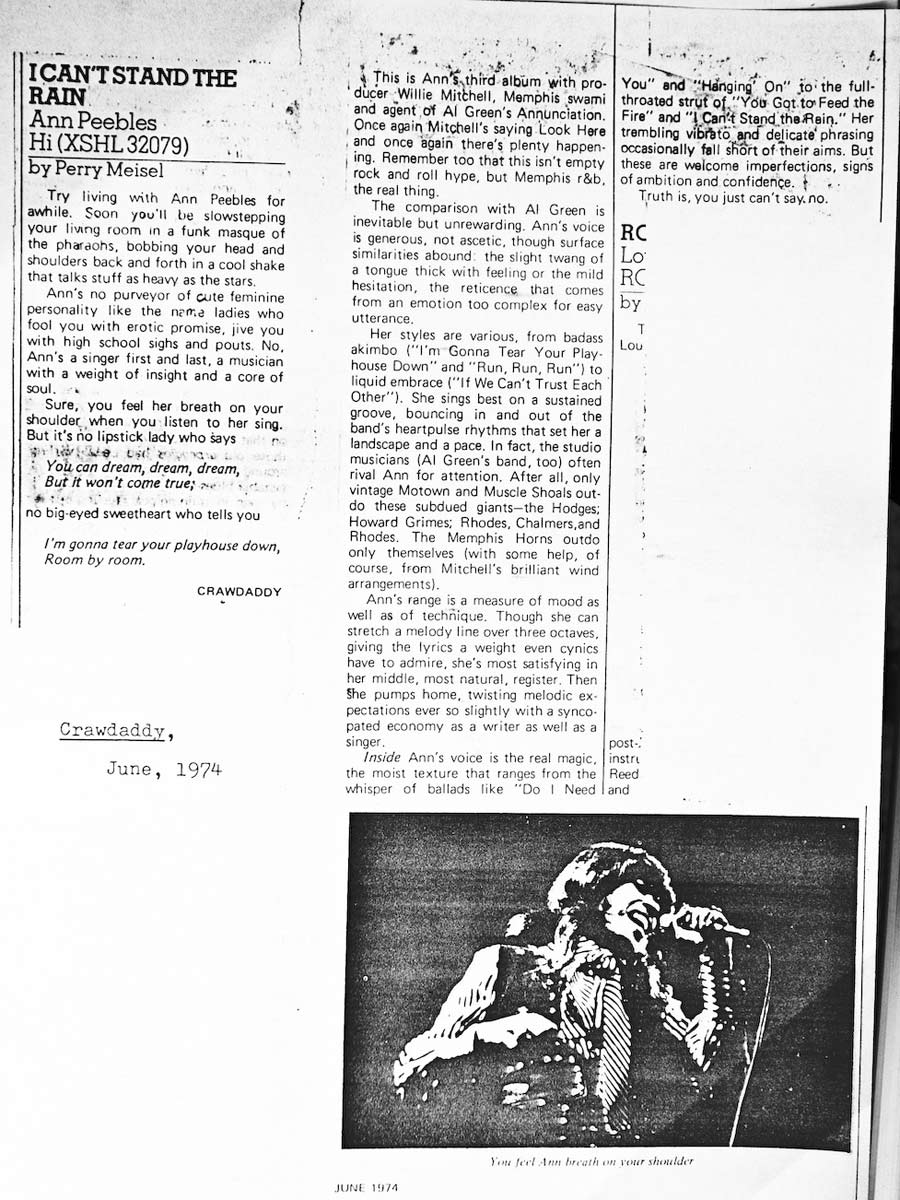
Ann Peebles: I Can't Stand the Rain

by Perry Meisel

Try living with Ann Peebles for awhile. Soon you'll be slowstepping your living room in a funk masque of the pharaohs, bobbing your head and shoulders back and forth in a cool shake that talks stuff as heavy as the stars.
Ann's no purveyor of cute feminine personality like the name ladies who fool you with erotic promise, jive you with high school sighs and pouts. No, Ann's a singer first and last, a musician with a weight of insight and a core of soul.
Sure, you feel her breath on your shoulder when you listen to her sing. But it's no lipstick lady who says
You can dream, dream, dream
But it won't come true
no big-eyed sweetheart who tells you
I'm gonna tear your playhouse down,
Room by room
This is Ann 's third album with producer Willie Mitchell, Memphis swami and agent of Al Green's Annuciation. Once again Mitchell's saying Look Here and once again there's plenty happening. Remember too that this isn't empty rock and roll hype, but Memphis r& b, the real thing.
The comparison with Al Green is inevitable but unrewarding. Ann's voice is generous, not ascetic, though surface similarities abound: the slight twang of a tongue thick with feeling or the mild hesitation, the reticence that comes from an emotion too complex for easy utterance.
Her styles are various, from badass akimbo ("I'm Gonna Tear Your Playhouse Down" and "Run, Run, Run") to liquid embrace ("If We Can't Trust Each Other"). She sings best on a sustained groove, bouncing in and out of the band's heartpulse rhythms that set her landscape and a pace. In fact, the studio musicians (Al Green's band, too) often rival Ann for attention. After all, only vintage Motown and Muscle Shoals outdo these subdued giants - the Hodges, Howard Grimes, Rhodes, Chalmers, and Rhodes. The Memphis Horns outdo only themselves (with some help, of course, from Mitchell's brilliant wind arrangements).
Ann's range is a measure of mood as well as of technique. Though she can stretch a melody line over three octaves, giving the lyrics a weight even cynics have to admire, she's most satisfying in her middle, most natural, register. Then she pumps home, twisting melodic expectations ever so slightly with a syncopated economy as a writer as well as a singer.
Inside Ann's voice is the real magic, the moist texture that ranges from the whisper of ballads like "Do I Need You" and "Hanging On" to the full-throated strut of "You Got to Feed the Fire" and "I Can't Stand the Rain." Her trembling vibrato and delicate phrasing occasionally fall short of their aims. But these are welcome imperfections, signs of ambition and confidence.
Truth is, you just can't say no.

Originally published in Crawdaddy, June, 1974

Sample view:


4/11/10

Al Green: Livin' For You

by Perry Meisel

There's been a lot of talk lately about a narcissistic Al Green, about a guy who for a while seemed to outclass everybody in sight but who now indulges in vain onstage displays, as though singing were a sideline and stardom a license for self-adulation. Sounds like a description of a successful rock and roll band, doesn't it? Perhaps that's one reason hip listeners have been disturbed. The astonishing subtlety that can swell the surface of a tune with unspoken ripeness has given way, claim the disenchanted, to a mere episodic brilliance, to a tantalizing local flare no longer bound to a larger sense of drama.
Livin' for You, then, is an important release, a test of those recent impressions. Superficially it seems like the rest of Al's records - cool and slow, scrupulously arranged and produced by Willie Mitchell. Al is cast, typically, as a jazz soloist; his voice the ultimate mix of grit and grace, funk and delicacy.
And yet it takes many listenings to begin to grasp his genius afresh and even more to distinguish it from the time-wasting that's also present. His moods are firmer now, more explicit than they used to be, with a new and unfortunate potential to freeze into hues less various than before. That sense of something won by the end of a tune seems absent much of the time too, that sense of pain turned to joy through the controlled emotion one has grown to expect from him.
For every triumph on the album there's something surprisingly tame. "Home Again" and "Free at Last" are exquisite ballads in the full Green style, opening in a breathy mood and filling in the throat over the slow bounce of the band. Yet "Sweet Sixteen" and "My God is Real" - both overtly blues-flavored, oddly enough - are marked by stalling, not invention. They're the chief examples of that drift into the frozen; an almost shallow brooding hangs motionless over both songs from start to finish. Like "Beware," which begins as a compact ballad (but which is the longest cut on the album), they also feature a thick instrumental middle, a rarity in Mitchell's usually chaste handling of Al's steady Memphis studio crew.
An increased use of electric piano causes the thickness. In spite of the superb playing, it obscures the real bones of the back-up, Charles Hodges' organ and Tennie Hodges' guitar. The clear presence of their sparse counterpoint is essential to the settings best for Al's voice; settings like those on "Home Again," "Free at Last" and, especially, on "So Good to be Here." The chorus,

So good to be here,
So good to see your face

is a stunning arrival musically as well as lyrically, for Al enters it from his low range in the last bar of the verse, ascending the scale of the refrain itself half in tenor, half in soprano, mirroring the sense of the words in the music. "Unchained Melody," on the other hand, parodies that success. The ascent to the chorus is made directly, over the tops of the notes on the climbing scale rather than under and through them. The landing is one of effect, not of feeling.
"So Good to be Here" is the album's most memorable tune, prettier than the other songs and more perfect vocally. It is compactly dramatic, wasting not a phrase in its reach through three moods, from offhand ease to braided tautness, much like "Free At Last," its only real rival.
Such economy and supple strength, though, are strangely hard to come by. There's more freedom in Mitchell's arrangements than ever before, calling for instrumental fills and even a short guitar solo on "My God is Real." What the looser settings do, however, is take the tension out of the whole sound (tension in the sense of structure, not harmonically but texturally). Al's singing suffers accordingly because too much of the burden of development is taken - intentionally? - away from him.
Mitchell's past arrangements were almost static, with the Memphis Horns or the strings alone embellishing the late choruses of songs. It brought out Al's particular genius for understatement and suggestion (which even by itself has canonized him among r&b singers), for he chose to lay back in the rhythm and insinuate rather than blurt it all out and finish the tune breathlessly (like so many singers), having run out of things to say. But insinuation occasionally becomes an end in itself here. Al's brilliant phrasing is no longer in the exclusive service of building up a tune. Sometimes he's just plain marking time, like on the title cut or on "Let's Get Married" (where the sentiment of resignation seems, mercifully, more a pose than a real assertion).
Somehow Al's characteristic intensity is too often missing, except in a few jewelled instances. Even the strings don't sound as sweet as they used to, as though a slack atmosphere reigned during the sessions. The last moments of the album (an attempt to end the excessive vamp on "Beware") are jarring and upsetting, for they contain the kind of joking finale one associates with Leon Russell. The very last thing on the record is Al Green's laughter, which probably began when the musicians couldn't end the tune. But as a way to end an album, it's pretty weird - not even Beatles giggling but big ha-ha's. I think I'll stick with Let's Stay Together.

Originally published in Crawdaddy, March, 1974

Sample view: